Not Yet

Toggle Wars · Track 2: AI agents and feature flags

Not yet.

An agent that reads your live Flagsmith experiment and refuses to call it before the plan says it is time.

For teams that run A/B experiments on Flagsmith and look at the result every day.

Needs Docker and Python 3.10+. The first run pulls Docker images, so the wait depends on your connection; we have not timed a cold run. No Docker: ./notyet check prereg.example.json --stats stats.example.json runs the offline demo.

  • RealSelf-hosted Flagsmith 2.295.2, its results, its chance to win and arm counts.
  • SimulatedAll experiment traffic. Our scripts send identities and events. No real user has used Not Yet.
  • BetaFlagsmith Experimentation is in Beta. Flagsmith Cloud was not tried.

The problem

Everyone checks. The chart crosses 95% by day two.

There is nothing to find, and the dashboard finds it anyway.

You start an A/B experiment. The plan says 800 identities per arm and 48 hours. On day two the chance to win reads 95.7%. It is green. Someone ships.

In the simulated run charted here there is no real effect at all: both arms are the same. The line still crosses 95% at 300 per arm and stays above it for most of the run.

That habit has a name, peeking. In 1000 simulated no-effect experiments, a team that ships at the first look above 95% ships a false winner 18.5% of the time. Judging once at the planned sample does it 5.1% of the time.

Simulated A/A run: chance to win at each look Chance to win rises above 95 percent at 300 identities per arm and stays near 97 percent, with no real effect. A peeker ships at 300. Not Yet answers NOT_YET at every look through 750 and INCONCLUSIVE at 800 with 94.9 percent. 75% 80% 85% 90% 95% 100% 100 200 300 400 500 600 700 800 identities per arm (one look every 50) Above 95%: a peeker ships Peeker ships here: 95.7% at 300 per arm. The simulated experiment has no real effect. 800 per arm, judged once: 94.9%, INCONCLUSIVE Not Yet answers at each look
SIMULATED A/A run, seed 24. Chance to win at each look, generated by src/rules/replay.py (our re-implementation of Flagsmith's documented formulas). Same numbers as the time machine in the UI. Plan: 800 per arm and 48 h. The run continues to 2000 per arm in the UI, where the verdict stays locked.
The product

One page. One verdict. A reason.

Not Yet answers NOT_YET, SHIP, DONT_SHIP, INCONCLUSIVE or BROKEN. A deterministic function decides. A language model, if you configure one, only words the explanation and can never change the verdict.

localhost:8511
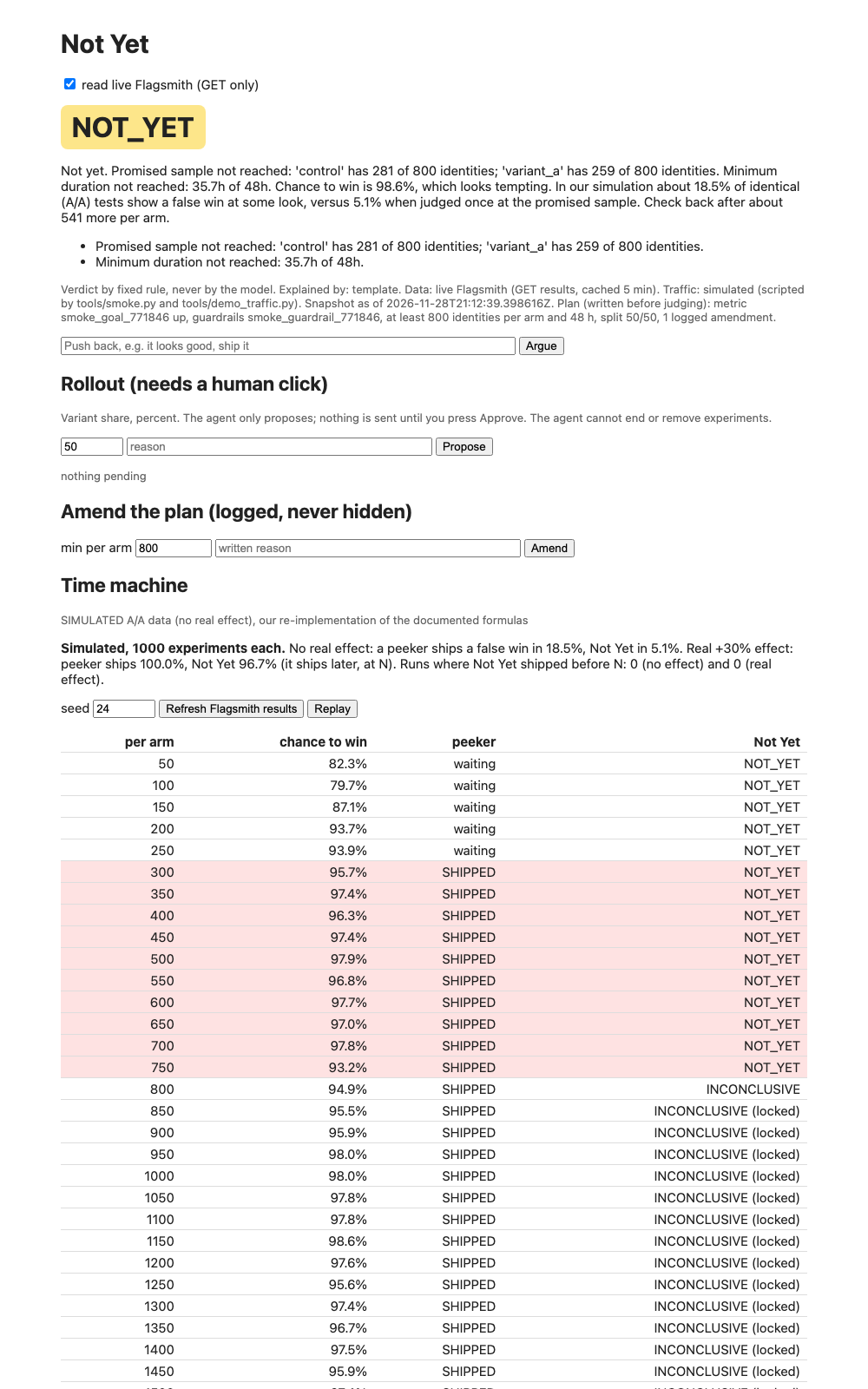
The Not Yet UI: a yellow NOT_YET verdict, with text saying control has 281 of 800 identities, variant_a has 259 of 800, 35.7 hours of 48, and a chance to win of 98.6 percent that looks tempting.
The verdict. It names the missing sample and hours, shows the chance to win next to the reason it does not count yet, and states what was real and what was simulated. Real screenshot, 29 Nov 2026.
localhost:8511 · time machine
The time machine table: per arm sample size from 50 to 650, the chance to win, whether a peeker would have shipped, and Not Yet's answer, which stays NOT_YET on every row.
The time machine. It replays a SIMULATED A/A experiment look by look. Red rows are looks where a peeker would already have shipped. Not Yet says NOT_YET on each of them. Real screenshot.

It writes the rule down first

A pre-registered plan holds the metric, direction, guardrails, split, minimum sample, minimum hours and thresholds. Changing it is an amendment with a written reason, and it is always shown.

It judges once, then locks

The first time the sample and hours are reached, the verdict is stored. Later looks return it marked Locked, so nobody can keep reading until a better answer appears.

It does the daily looking

./notyet watch refreshes, reads and applies the rule on a schedule. It prints a blind progress line and never the chance to win, so the person reading cannot peek.

How it works

Flagsmith in, a verdict out, a person in the loop.

How Not Yet works The reader gets results from the Flagsmith experiment. decide() applies the pre-registered plan and the judged-once lock to produce a verdict. The verdict goes to an explanation and to the audit file, and may become a rollout proposal. A human approves, then a PATCH changes the rollout in Flagsmith. Flagsmithexperiment + results ReaderGET only, 5 min cache decide()fixed rule, no model VerdictNOT_YET, SHIP, DONT_SHIP, ... Pre-registered planjudged once, then locked Wordstemplate or model Auditaudit.jsonl SHIP or DONT_SHIP only Rollout proposal100% or 0%, pending A second person approvesproposer cannot approve PATCH rolloutthe only write to an experiment back to Flagsmith
  1. Pre-register. Write the plan before the experiment is judged: metric, direction, guardrails, minimum sample and hours.
  2. Read. The reader calls Flagsmith over REST with GET only and keeps a 5-minute cache. Refreshing is a separate, explicit step.
  3. Decide. decide() applies the rule. Before the plan is finished the answer is NOT_YET, even if the numbers look decisive.
  4. Lock and record. The first final verdict is stored. Every read, verdict and proposal goes to audit.jsonl.
  5. Propose. At SHIP or DONT_SHIP the agent creates a rollout proposal, 100% or 0%, and waits.
  6. Approve. A named second approver clicks. Only then does the PATCH go to Flagsmith. No code path ends or removes an experiment.

What you see

Five answers, in a fixed order.

Checks run top to bottom, so a broken experiment is never reported as a win, and a promised sample is never skipped because the numbers look good.

BROKEN

Sample ratio mismatch (chi-square p < 0.001 once 100 identities are in), the experiment is not running, an arm has had no exposures too long, or a metric is missing or points the wrong way.

Raises an alarm, then the watcher stops.

NOT_YET

Fewer identities per arm than promised, or fewer hours than promised, even when the chance to win looks decisive.

Says what is missing, for example 541 more per arm.

SHIP

The plan is met and Flagsmith labels the variant Winning, above 95% by default.

Creates a 100% rollout proposal for a person.

DONT_SHIP

The plan is met and Flagsmith labels the variant Losing, below 5% by default.

Creates a 0% rollout proposal for a person.

INCONCLUSIVE

The plan is met and the result sits between the thresholds. Said as inconclusive, not rounded up.

No proposal. A person decides.

With two or more guardrail metrics, the verdict states how likely at least one false Losing is (about 14% for three). A plan can opt in to Bonferroni correction; the default is none.

Who decides

The agent looks. A person decides.

The agent does alone

  • Reads the experiment's results from Flagsmith over REST at every look.
  • Asks Flagsmith to recompute results, at most every 10 minutes.
  • Applies the pre-registered rule. Before the plan is finished it prints only a blind progress line.
  • At SHIP or DONT_SHIP, creates a rollout proposal and notifies.
  • Writes every read, verdict and proposal to audit.jsonl.

It stops for a person

  • Approving any rollout change. A second named approver must click; the proposer cannot.
  • INCONCLUSIVE. No proposal, a person decides.
  • BROKEN. Alarm, then it stops.
  • Changing the plan. An amendment with a written reason, recorded and shown.
  • Ending or removing an experiment. No code path does it.
audit.jsonl excerpt, 28 Nov 2026 UTC. Traffic SIMULATED.
19:05:53 watch_look  look 1, NOT_YET, identities
         control 281 / variant_a 259, 33.6 h,
         refreshed, agent_seconds 5.08
19:06:31 proposal    01ddac5d rollout experiment 3
         "variant to 45%"  by approver:ana
19:06:31 approval    01ddac5d by approver:ben
19:06:31 patch       01ddac5d status 200

Our scripted two-person check

Approver ana proposed a rollout. When ana tried to approve her own proposal, she was refused with a 403, which is not an audit line. ben approved, and Flagsmith answered the PATCH with 200.

The proposals in that excerpt came from our check script, not from watch, which only proposes at a final verdict. Other agents can use Not Yet through a small stdio MCP server: notyet_verdict, notyet_propose_rollout and notyet_pending. There is no approve tool.

How we use Flagsmith

Built on Flagsmith Experimentation.

Tested against self-hosted Flagsmith 2.295.2, pinned in docker-compose.yml, and the Flagsmith Python SDK flagsmith>=6.3.0. The only write calls in the code are the rollout PATCH and the refresh POSTs, plus setup in tools/.

Flagsmith featureHow Not Yet uses itCode
Multivariate flag with an optionDemo flag with one varianttools/smoke.py
Experiment metrics (occurrence, up or down)A goal metric and a guardrail metric, matched to the plan by name and directiontools/smoke.py, src/reader/flagsmith_reader.py
Experiments: create and startCreates and starts the demo experimenttools/smoke.py
SDK get_experiment_flag and track_eventScripted identities get an arm and send goal and guardrail eventstools/demo_traffic.py
Warehouse connection (Postgres)Created for each environment at bootstraptools/bootstrap.py
GET experiments/{id}/results/, experiments/{id}/, experiment-metrics/The reader: chance to win, arm counts, running status, metric namessrc/reader/flagsmith_reader.py
POST exposures/refresh/ and results/refresh/An explicit, separate refresh step, never triggered by the readersrc/reader/refresh.py
PATCH experiments/{id}/rollout/Sent only after a human approvalsrc/agent/flagsmith_send.py
Winning (above 95%) and Losing (below 5%) labelsThe default thresholds of the plansrc/rules/decide.py

Proof

What the simulation shows, and what it does not.

Every number in this section comes from simulated experiments. 1000 per row, base rate 30%, one look per 50 identities per arm up to 2000, N = 800. Run python tools/headline_sim.py to reproduce it in about a second.

No real effect (A/A)

SIMULATED. How often a false winner ships.

Peeker, ships at first look above 95%18.5%
Not Yet, judged once at N5.1%
0%20%

Lower is better. Not Yet still has a roughly 5% false win rate at N, because the threshold is 95%.

Real +30% lift

SIMULATED. How often the real winner ships.

Peeker100%
Not Yet, later, at N96.7%
0%100%

Higher is better. Not Yet ships later and loses about 3 points of power here. It is not a free lunch.

By construction the rule cannot ship before N; that is a property of the rule, not a simulation finding. In the 1000 runs per row, Not Yet shipped before N in 0 of them. The table comes from summary.sim.json, and tests/test_replay.py fails if it stops reproducing. A separate peeking check (tools/peek_sim.py, 3000 A/A runs, seed 1) found a false win at some look in 18.2% of runs and 4.2% at the final look.

ThingStatus
Flagsmith, its results, its chance to win, arm countsReal. Self-hosted Flagsmith. Our development runs used a shared self-hosted instance; the quick start starts your own.
Traffic in the live experimentSimulated. tools/smoke.py and tools/demo_traffic.py send scripted identities and events through the Flagsmith SDK, not real users.
Time machine dataSimulated A/A, no true effect, generated by src/rules/replay.py.
Peeking numbersOur re-implementation of the documented formulas, not Flagsmith's code.
Rollout PATCHReal, tested on our own throwaway experiment (50 to 40 to 50, and 45 to 50).

Checked against Flagsmith. Local chance to win computed from Flagsmith's own n and sum matches Flagsmith's value to 9 decimals on two metrics at two looks of our live experiment (206/184 and 281/259 identities), using tools/verify_replay.py. Same experiment, same two occurrence metrics, not tested on count, sum or mean metrics.

What it does not do

The limits, up front.

  • No real users.Nobody outside the project has used Not Yet. There is no user feedback to report.
  • It does not make decisions faster.It makes them later, at N. "Saves real time" is not measured; we have no timing study.
  • The rule is not new.Fix the sample in advance and judge once is standard fixed-horizon practice. What we add is the wiring to a live Flagsmith experiment.
  • The chance to win is not hidden everywhere.Only notyet watch is blind. check and the UI show it during NOT_YET, next to the reason it does not count.
  • Approval is a token, not a login.Per-person tokens and a two-person rule. No sessions or roles. A proposal made by the agent can be approved by any one approver.
  • Local files are trusted.Someone who hand-edits prereg.live.json or judgement.json bypasses the checks.
  • Two arms, occurrence metrics.The reader takes the first treatment arm. The replay covers occurrence metrics, and the headline uses the up direction only.
  • The model path is stale.Explanations with a model last ran on 27 Nov. Every later check used the template. The verdict is never the model's call.
  • MCP has not met a model.Tested with the official MCP SDK client, but not in a real agent session, and not listed in any marketplace.
  • No hosting yet.There is no public repository, demo video or hosted demo.

Run it

Your own Flagsmith, a demo experiment, tests.

Needs Docker and Python 3.10+. The first run pulls Docker images, and the bootstrap step waits up to 120 seconds for Flagsmith to answer. We have not timed a cold run. Success looks like SMOKE OK and a green test run at the end. Step-by-step guide for a first-time visitor.

Quick start
./quickstart.sh
# own Flagsmith 2.295.2 + Postgres, venv,
# demo experiment (SIMULATED traffic), tests

# other port or interpreter
FS_PORT=18501 ./quickstart.sh
PYTHON=/path/to/python3.11 ./quickstart.sh
Offline demo, no Flagsmith needed
./notyet check prereg.example.json \
  --stats stats.example.json

# after the quick start
./notyet watch prereg.live.json --once
python src/ui/server.py   # UI on :8511
Tests, hermetic: no Flagsmith, no model
python -m pytest -q
# 87 test cases in 61 test functions

The tests cover the rule, plan amendments, the judged-once lock, the reader and UI server, the watch loop, actions and approvers, the explanation checks, the replay and headline table, and the MCP server. They do not cover a live Flagsmith or a model. quickstart.sh never runs docker compose down and is safe to re-run; each run creates a new demo flag and experiment.